
Research Platform
Generative Autonomous-Driving Simulation Platform
A Cosmos-Transfer2.5 world model turned into a production simulation platform: sensor-level 7V generation, real-map scenarios, a WorldSim↔WorldModel bridge, 4-step distillation of 7V surround video, and one denoiser that serves three jobs.
Overview
What is this project about?
Real driving logs cannot cover the rare interactions that matter most, and collecting them is slow, expensive and unsafe. Generated video could fill the gap — but a 35-step surround-video diffusion model is far too slow to sit inside a closed simulation loop.
A 7-camera surround world model on Cosmos-Transfer2.5, driven by real-map layouts (Ingolstadt OSM → BEV layout → 7V video) and connected to our closed-loop simulator over a semantic bridge, so a scenario can be authored, generated and edited rather than waited for.
Four-step distillation (bridge consistency plus distribution matching) cut the sampler from 35 steps to 4 for up to ~13.9× faster rollouts, and a single denoiser now serves layout generation, Gaussian-Splatting repair and harmonization instead of three separately trained models.
My role. I own the distillation track end to end — schedule design, the alternating student/critic training loop, and the progressive 35→4→2→1 cascade — and the OneModel unification that collapsed three task-specific models into one. The platform itself is a team effort; scenario authoring and simulator integration are shared work.
This platform is the parent effort. Vector Traffic Generation & Sensor-Level Closed-Loop Simulation is the track inside it that decides what the traffic does and how the result is re-rendered.
01 · Cosmos-Transfer2.5 on internal driving data
A 7V generative world model, built on Cosmos-Transfer2.5 and validated on internal data.
02 · Real maps → 7V video (Ingolstadt OSM)
Download a real city map (OSM), convert it to the model's layout, and generate surround video — including a snow variant.
03 · Flux → single-frame 7V: weather, season & style transfer
Lift a single-image Flux generator into a 7V surround model — one synchronized frame across every camera — then drive it with text to restyle the whole rig into new weather, seasons, and looks while the underlying geometry stays put.
04 · WorldSim ↔ World Model gRPC bridge
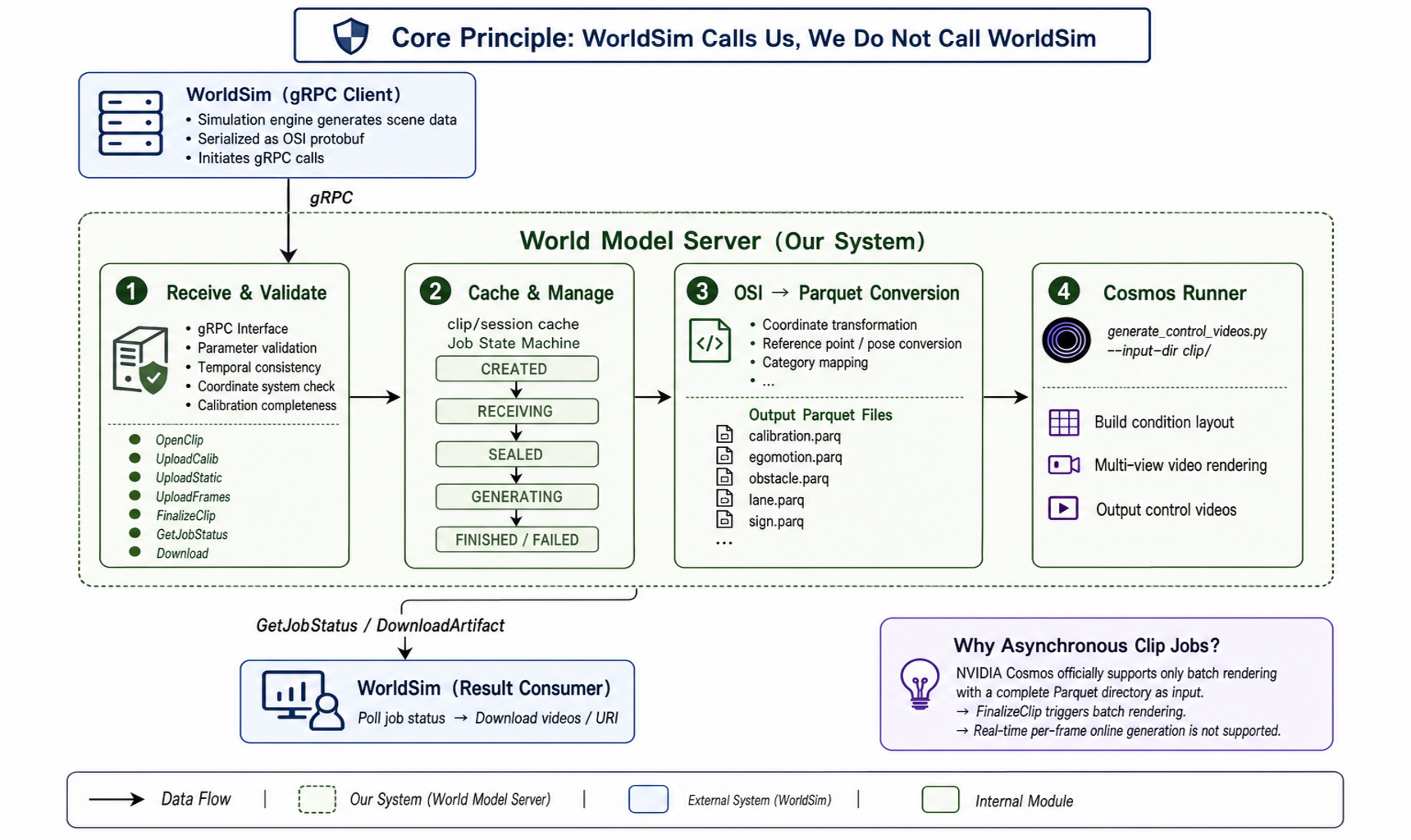
05 · First 4-step distillation of 7V surround video
View as tablesame content, no interaction needed
| Stage | Input | Logic | Output | Why / role |
|---|---|---|---|---|
| 35-step Teacher Teacher frozen | Real frames and their conditions | Run the slow, exact denoising trajectory | Reference path plus the student's initial weights | Freezing the teacher gives the student a target that cannot drift; if both moved, there would be nothing anchoring the compression to reality. |
| 4-step Student Student | Teacher weights as initialisation | Take four large denoising steps, with classifier-free guidance folded into a single forward | Few-step samples | Baking guidance into the weights removes the second forward pass per step — the speedup compounds with the step reduction rather than fighting it. My role. Designed and trained the student; owned the distillation track end to end. |
| Sparsify Timesteps Schedule train-only | The teacher's noise-level schedule | Index-mapped sub-sampling of the teacher's timesteps | Four student steps, each covering a teacher span | Where the four steps land matters more than how many there are — a bad schedule wastes a step on a range where almost nothing changes. |
| Dynamic Critic Critic train-only | The student's current samples | Learn a score for the student's evolving output distribution | A direction back toward the real distribution | A fixed critic goes stale the moment the student improves; retraining it alongside keeps the supervision meaningful for the whole run. Trade-off. A trainable critic doubles the moving parts — the price is the alternating loop below. |
| Bridge Consistency Loss · path train-only | A teacher span and the matching student step | Match the average velocity across the bridged span | Path gradient | Matching average velocity over a span, rather than the endpoint, is what lets one student step legitimately replace many teacher steps. |
| Distribution Matching Loss · look train-only | Teacher and critic scores | Push the student's output distribution toward the real one | Distribution gradient | Path correctness alone yields blurry frames; this is the loss that buys back the sharpness few-step sampling normally loses. |
| Alternating Optimisation Loop train-only | Student and critic | Update the critic and the student in alternation, never in one graph | A stable training loop | Two adversarial-style networks in one backward graph is where 7-view video distillation runs out of memory; alternating keeps the graph small enough to fit. Trade-off. Alternating costs wall-clock steps, but it is the difference between training and not training at all at this resolution. |
| Progressive Compression Cascade train-only | The model from the previous level | Halve the step count, initialise from the level above | The next-level student | Jumping straight to one step diverges; halving keeps every level close enough to its teacher that the optimisation stays well-behaved. |
| 4-step 7V Model Result | Path and distribution gradients | Four forward passes, seven views kept mutually consistent | Surround video at interactive speed | Speed is not a vanity metric here: below a certain rollout time the world model simply cannot sit inside the simulation loop at all. My role. Measured the speedup and integrated the distilled sampler into the platform. |
| Mode | Spec | Original | Distilled | Speedup |
|---|---|---|---|---|
| Single clip (first) | 29 / 203 frames | 796.76 s | 106.32 s | 7.49× |
| Single clip (steady) | 29 / 203 frames | 744.16 s | 53.68 s | 13.86× |
| Auto-regressive (long) | 57 / 399 frames | 1546.87 s | 165.87 s | 9.33× |
Distilled 4-step model — surround generation at a fraction of the cost.
Editable platform — rare interaction scenarios
Edit the layout on a real clip, then regenerate with the 4-step model to produce hard-to-collect interaction data.
06 · All-in-one OneModel — three modes, one denoiser
View as tablesame content, no interaction needed
| Stage | Input | Logic | Output | Why / role |
|---|---|---|---|---|
| Shared Backbone Backbone | Conditions and a start latent | One 7-view video diffusion model | The same weights, driven three ways | Three task-specific models meant three trainings, three checkpoints and three sets of drift. One backbone means an improvement anywhere lands everywhere. Trade-off. A shared backbone cannot be tuned to death for any single task — worth it while all three tasks are still moving. My role. Designed and owned the OneModel unification. |
| Layout Generation Mode 1 | Layout video + camera/time/7V | Generate from pure noise | Driving-scene video | Controllable surround generation |
| GS Fix Mode 2 | Degraded GS video + optional layout | Denoise from degraded start | Clean video | Fills holes / artifacts |
| Harmonizer Mode 3 | Disharmonized video + mask | ControlNet harmonization | Harmonized video | Natural fg/bg lighting |
| Pure Noise Start | Gaussian noise | Standard diffusion start | Latent to adapter | Maximum freedom |
| Degraded GS Latent Start | Low-quality GS render | Noise = the degradation itself | Latent to adapter | Keeps the real structure |
| Disharmonized Video Start | Inserted-asset video | Disharmony as the condition | Latent to adapter | Targets only the mismatch |
| Unified Condition Adapter Control | Layout / GS / disharmony / mask | Encode + inject into denoiser | Conditioned features | Three tasks, one control path |
| Shared Denoiser Denoise | Conditioned latent | Predict clean, consistent 7V | Denoised latent | One model holds all consistency |
| 7V Video Output Output | Decoded latent | Layout · GS-fix · harmonized | High-quality surround video | One model serves three tasks |