My research centers on generative world models, scene flow, LiDAR odometry,
3D/4D perception, and end-to-end driving. Looking ahead, I am building toward
closed-loop simulation that couples reconstruction with one-step generation,
streaming generation, and one-step video / image synthesis.
Generative World Models
Scene Flow
LiDAR Odometry
3D / 4D Perception
End-to-End Driving
ICMLAccepted · Spotlight2026
VectorWorld: Efficient Streaming World Model via Diffusion Flow on Vector Graphs
Chaokang Jiang, Desen Zhou, Jiuming Liu, Kevin Li Sun
Bosch ChinaResearch Collaboration
Rolling a driving world model forward on dense BEV rasters is expensive, which is what keeps world models out of streaming use.
Contribution. It runs the diffusion flow over a compact vector graph of agents and lanes instead of a dense raster, so rollout cost scales with the number of scene elements rather than with resolution — cheap enough to generate the future as a stream.
RegFormer++: An Efficient Large-Scale 3D LiDAR Point Registration Network with Projection-Aware 2D Transformer
Jiuming Liu, Guangming Wang, Zhe Liu, Chaokang Jiang, Haoang Li, Mengmeng Liu, Tianchen Deng, Marc Pollefeys, Michael Ying Yang, Hesheng Wang
Research Collaboration
Large-scale LiDAR registration is dominated by the cost of attention over hundreds of thousands of unordered points.
Contribution. It keeps the registration in 3D but moves the attention onto a range projection, so a 2D transformer carries the heavy computation while the point geometry stays exact — no voxel downsampling, no hand-built descriptors.
DifFlow3D: Hierarchical Diffusion Models for Uncertainty-Aware 3D Scene Flow Estimation
Jiuming Liu, Weicai Ye, Guangming Wang, Chaokang Jiang, Lei Pan, Jinru Han, Zhe Liu, Guofeng Zhang, Hesheng Wang
Research Collaboration
Scene-flow networks return one motion vector per point and no indication of when that vector should not be trusted.
Contribution. It refines flow as a hierarchical, coarse-to-fine diffusion process and reads per-point uncertainty directly out of that process — the journal extension of the CVPR 2024 method.
Unsupervised Learning of 3D Scene Flow With LiDAR Odometry Assistance
Guangming Wang, Zhiheng Feng, Chaokang Jiang, Jiuming Liu, Hesheng Wang
SJTU IRMVResearch Collaboration
Point-level motion labels for LiDAR barely exist, so supervised scene flow does not scale beyond curated datasets.
Contribution. It supervises scene flow with LiDAR odometry instead of annotations: ego-motion already explains the rigid part of the observed flow, leaving the network to learn only the part that genuinely moves.
Mamba4D: Efficient 4D Point Cloud Video Understanding with Disentangled Spatial-Temporal State Space Models
Jiuming Liu, Jinru Han, Lihao Liu, Angelica I. Avilés-Rivero, Chaokang Jiang, Zhe Liu, Hesheng Wang
Research Collaboration
Attention over a 4D point-cloud video costs quadratically in sequence length, which caps how much history a model can afford to look at.
Contribution. It splits the spatial and temporal axes into separate state-space models, so long point-cloud videos are processed in linear time and longer histories become affordable.
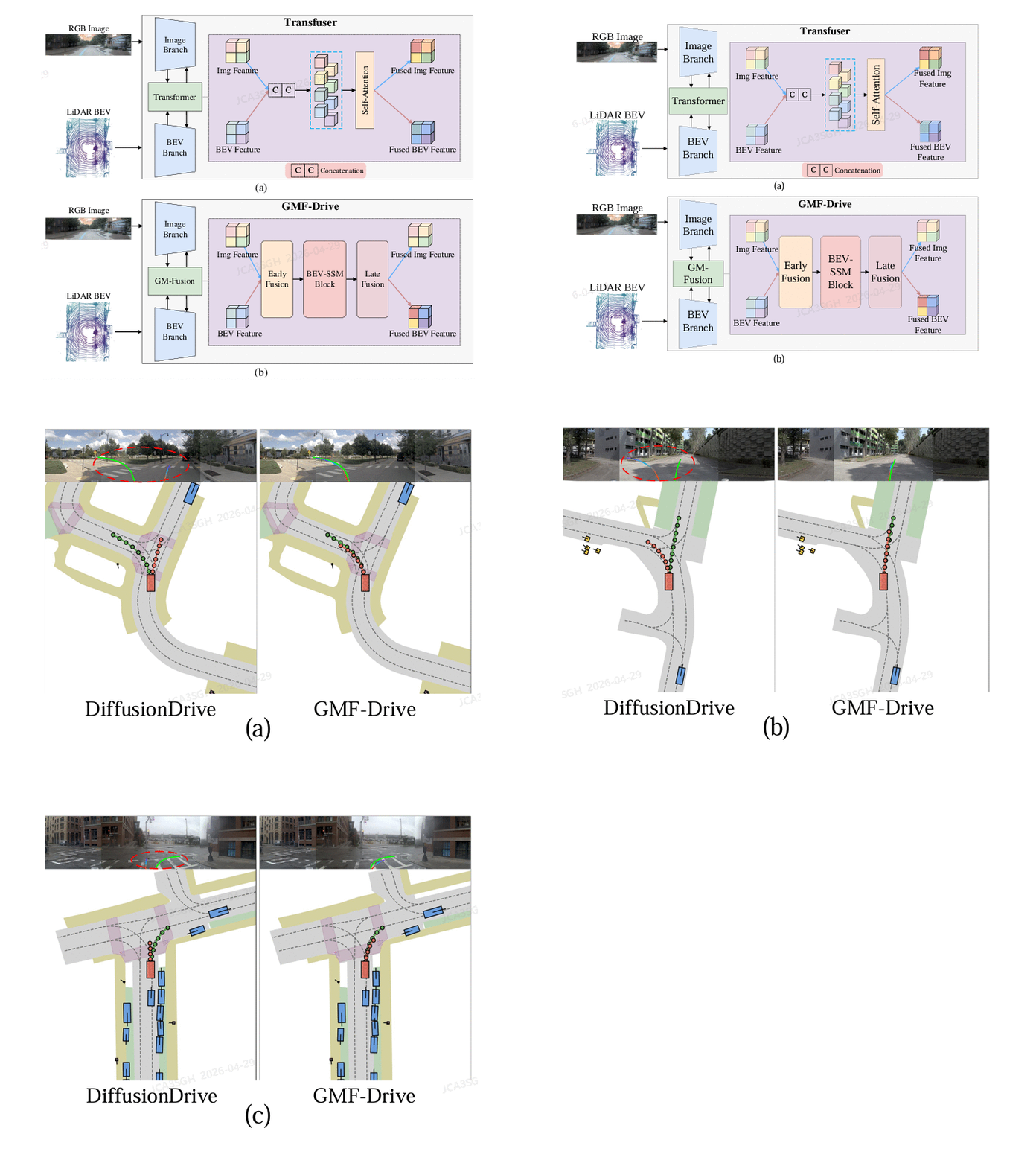
GMF-Drive: Gated Mamba Fusion with Spatial-Aware BEV Representation for End-to-End Autonomous Driving
Jian Wang, Chaokang Jiang, Haitao Xu
Research Collaboration
In end-to-end driving stacks, BEV sensor fusion is usually the most expensive block in the network.
Contribution. It replaces BEV attention with a gated Mamba fusion that keeps spatial structure explicit, trading quadratic attention for linear sequence modelling at the fusion stage.
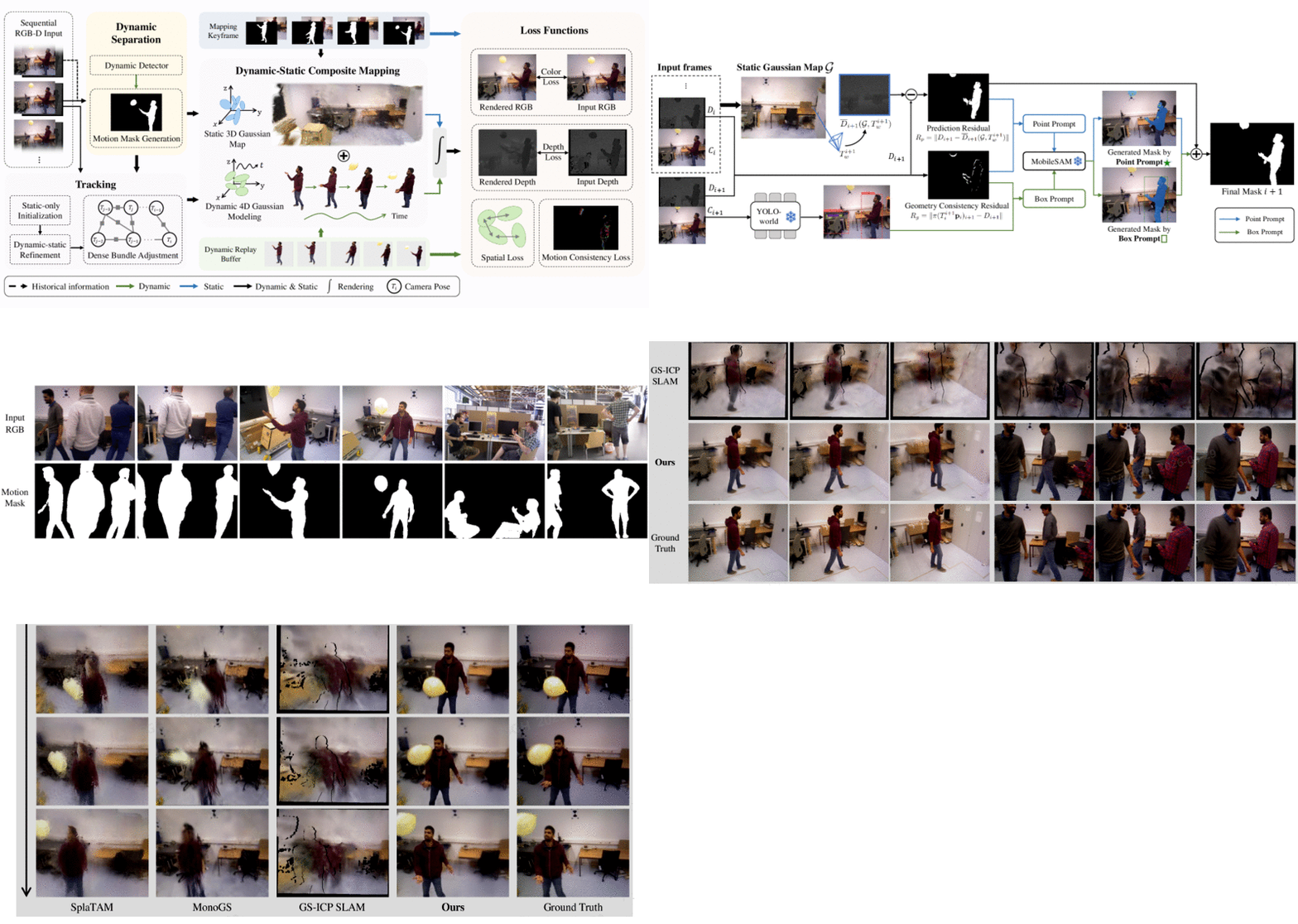
Gaussian-splatting SLAM assumes a static world, so every moving object is reconstructed as an artefact smeared across the map.
Contribution. It gives the map a fourth dimension: dynamic content is carried by time-varying Gaussians, so moving objects are modelled explicitly instead of corrupting the static reconstruction.
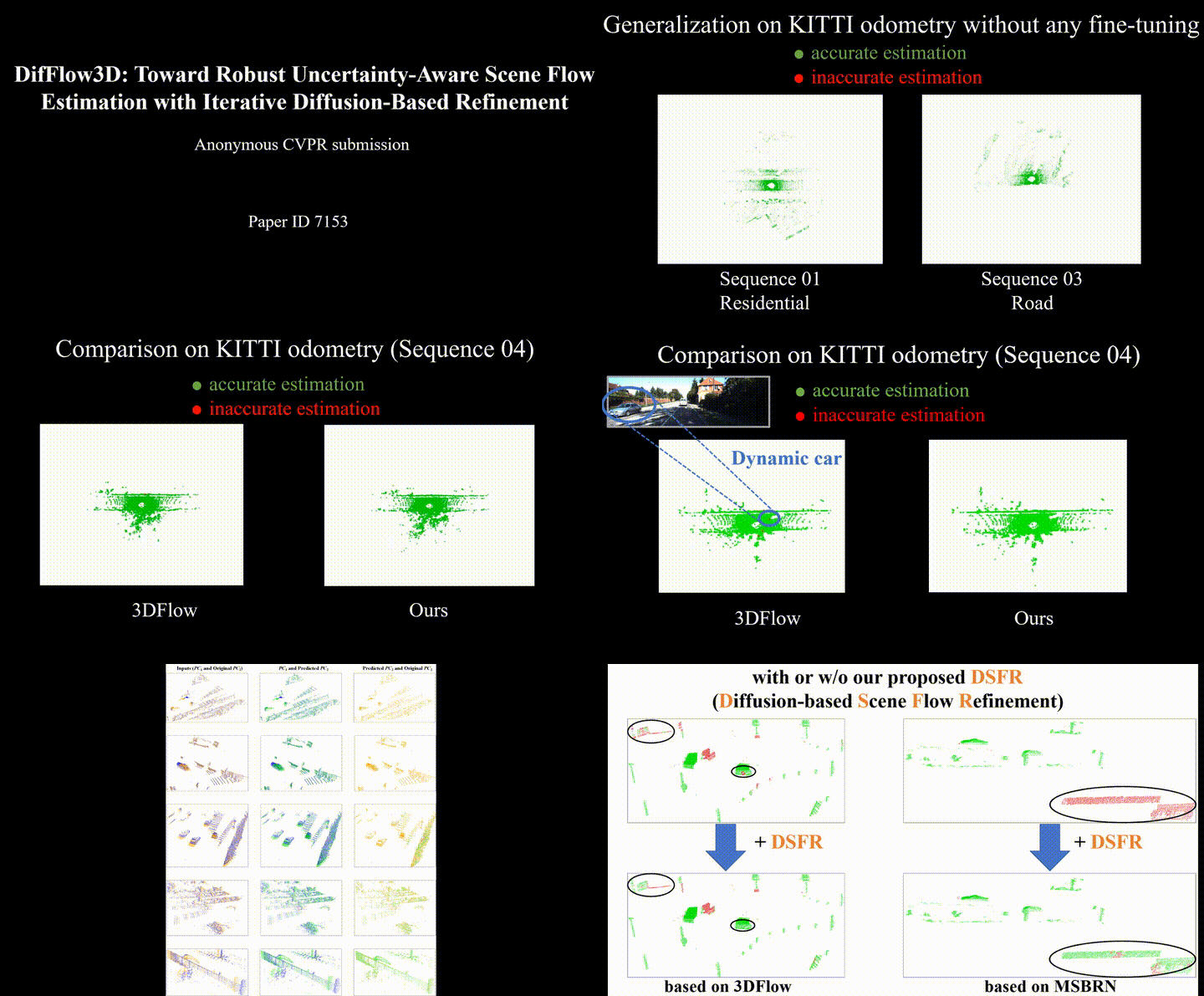
DifFlow3D: Toward Robust Uncertainty-Aware Scene Flow Estimation with Iterative Diffusion-Based Refinement
Jiuming Liu, Guangming Wang, Weicai Ye, Chaokang Jiang, Jinru Han, Zhe Liu, Guofeng Zhang, Dalong Du, Hesheng Wang
SJTU IRMVResearch Collaboration
Single-shot scene-flow regression collapses on large or ambiguous motion, and gives no signal about which predictions are unreliable.
Contribution. It casts flow refinement as an iterative diffusion conditioned on the previous estimate, which recovers the motions regression averages away and yields a per-point reliability estimate as a by-product.
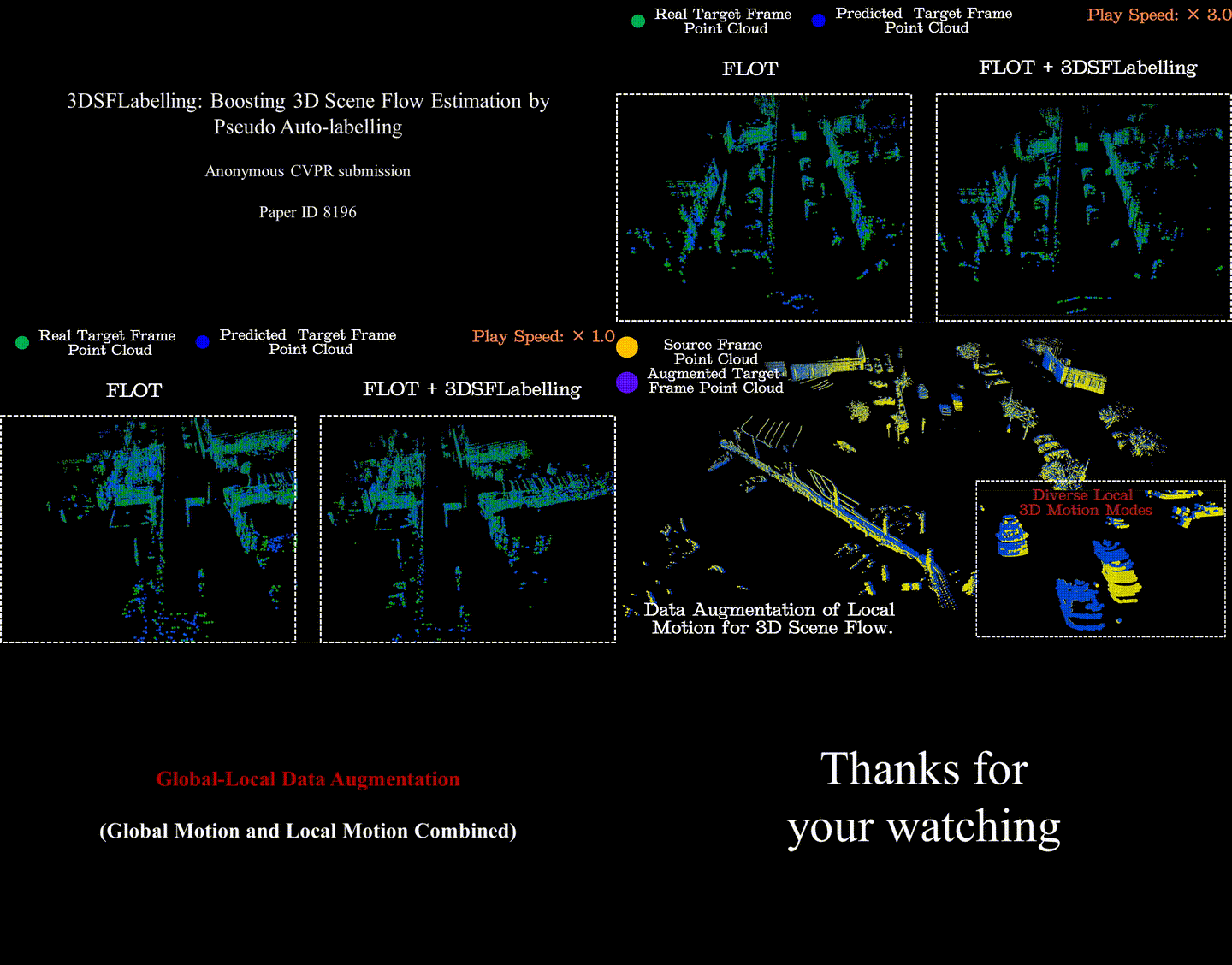
3DSFLabelling: Boosting 3D Scene Flow Estimation by Pseudo Auto-labelling
Chaokang Jiang, Guangming Wang, Jiuming Liu, Hesheng Wang, Zhuang Ma, Zhenqiang Liu, Zhujin Liang, Yi Shan, Dalong Du
SJTU IRMVPhiGent RoboticsResearch Collaboration
Point-level 3D motion is effectively impossible to annotate by hand, so scene-flow models are trained on synthetic data and then meet real LiDAR.
Contribution. It manufactures the missing labels from real LiDAR itself — fitting and augmenting per-object rigid motion to produce pseudo ground truth — so training happens on the same sensor and domain that deployment does.
NeuroGauss4D-PCI: 4D Neural Fields and Gaussian Deformation Fields for Point Cloud Interpolation
Chaokang Jiang, Dalong Du, Jiuming Liu, Siting Zhu, Zhenqiang Liu, Zhuang Ma, Zhujin Liang, Jie Zhou
Research Collaboration
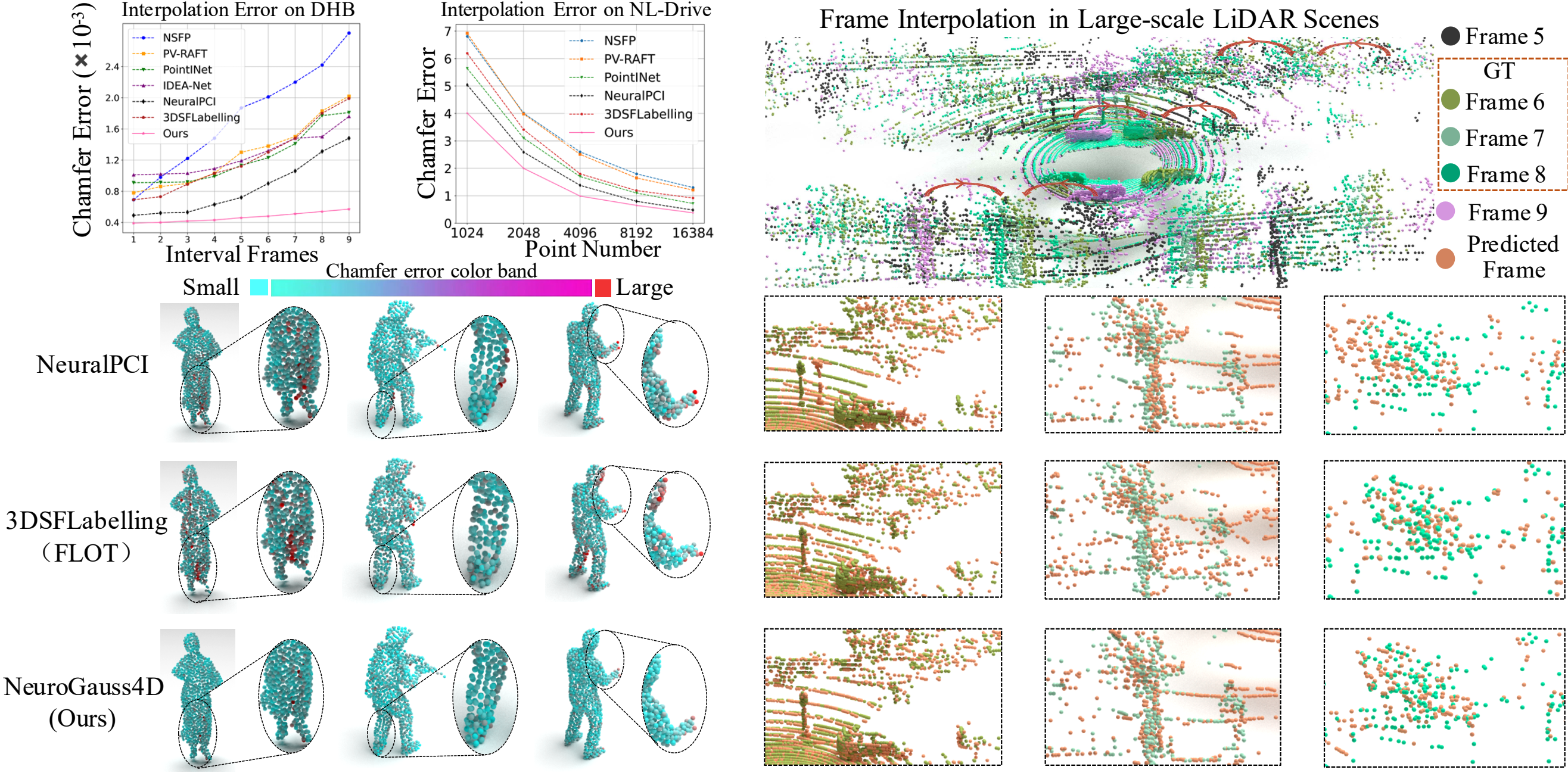
Interpolating between two LiDAR sweeps means inventing the geometry that neither sweep observed.
Contribution. It couples a 4D neural field with a Gaussian deformation field, so an intermediate frame is a continuous deformation of the scene rather than a per-point correspondence guess.
3-D Scene Flow Estimation on Pseudo-LiDAR: Bridging the Gap on Estimating Point Motion
Chaokang Jiang, Guangming Wang, Yanzi Miao, Hesheng Wang
CUMTSJTU IRMV
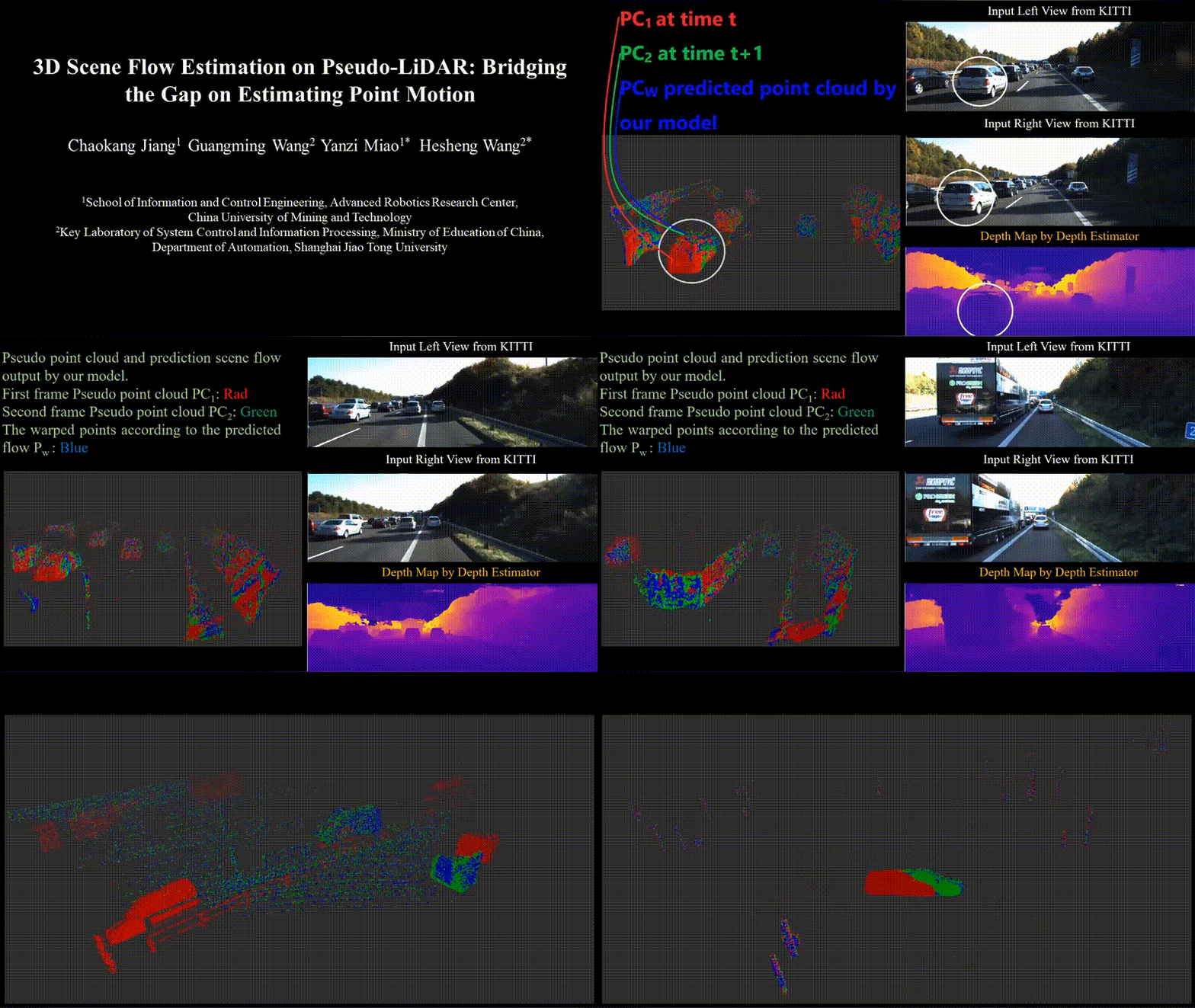
Scene flow is normally treated as a LiDAR problem, which leaves camera-only platforms with no way to estimate point motion at all.
Contribution. It estimates 3D point motion on pseudo-LiDAR lifted from images, and characterises where that lifted geometry helps and where its depth error dominates.
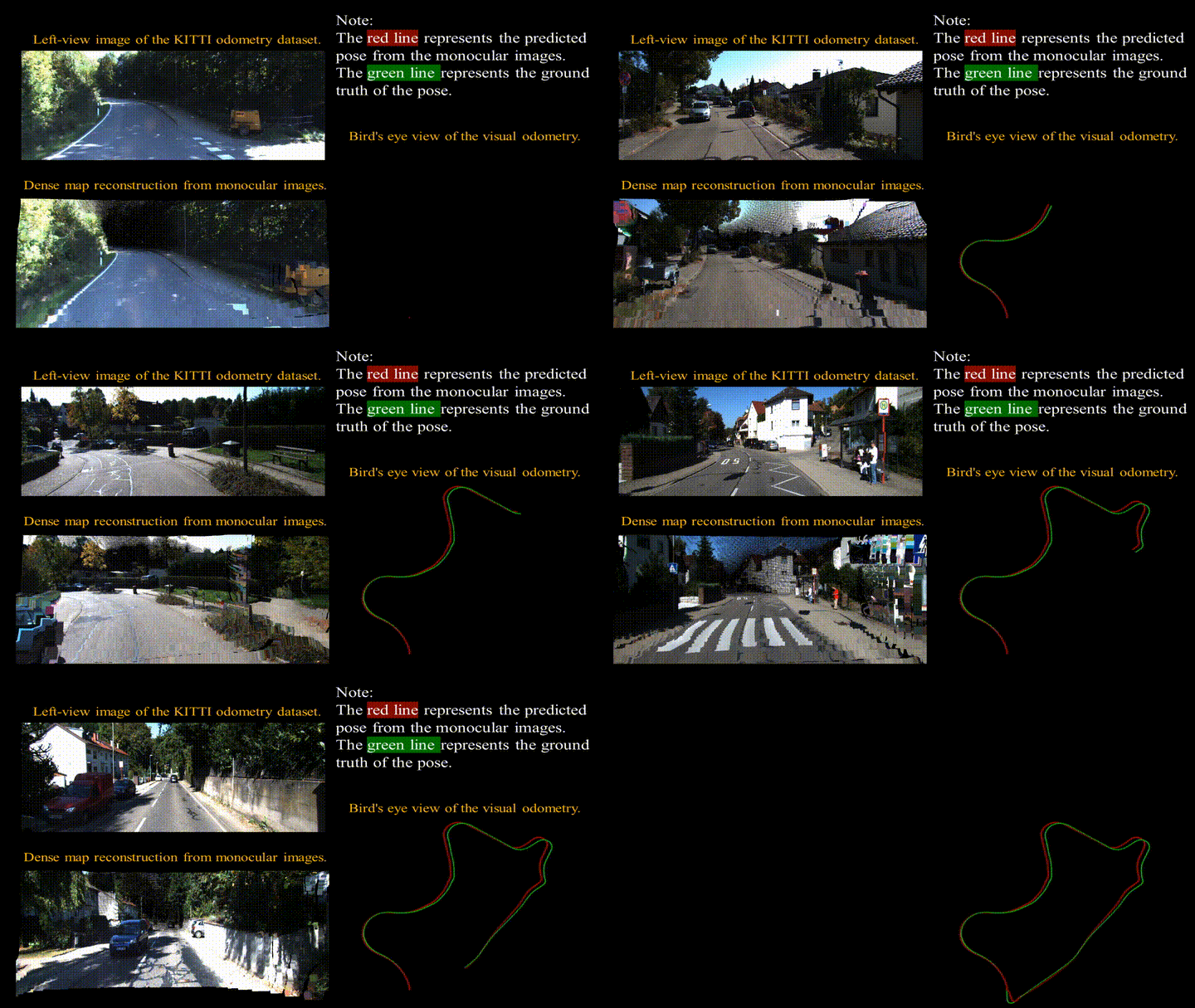
Visual odometry matches features on the image plane, where scale is ambiguous and geometry has to be recovered indirectly.
Contribution. It lifts images into pseudo-LiDAR first and estimates pose in metric 3D, so a camera-only system can use a geometric odometry formulation.
TransLO: A Window-Based Masked Point Transformer Framework for Large-Scale LiDAR Odometry
Jiuming Liu, Guangming Wang, Chaokang Jiang, Liu Zhe, Hesheng Wang
SJTU IRMVResearch Collaboration
Point transformers do not fit a full-size LiDAR scan: global attention over every point is out of reach at scan scale.
Contribution. It confines attention to local windows and masks out the empty ones, which is what makes a transformer viable for odometry on complete large-scale scans.
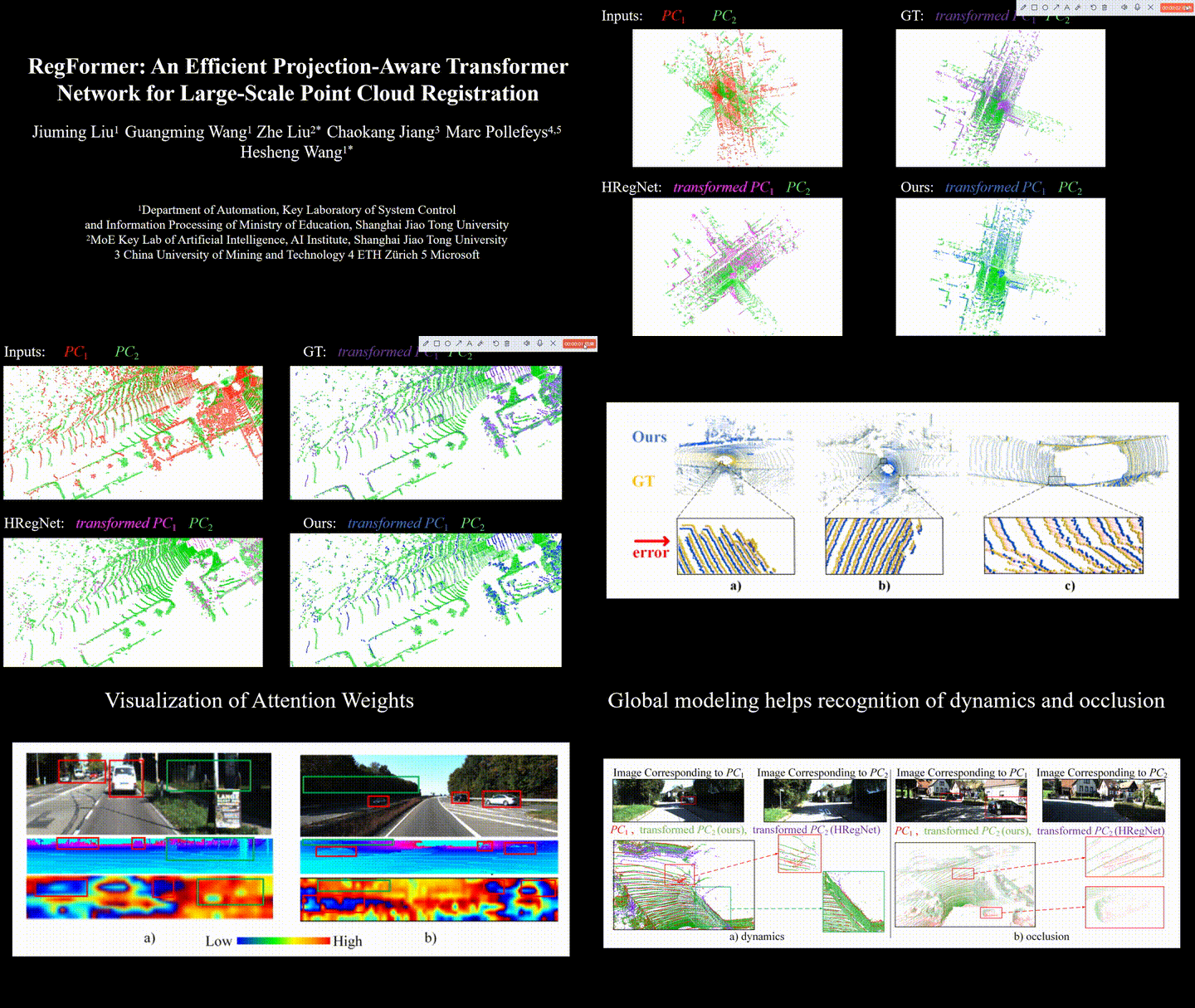
RegFormer: An Efficient Projection-Aware Transformer Network for Large-Scale Point Cloud Registration
Jiuming Liu, Guangming Wang, Zhe Liu, Chaokang Jiang, Marc Pollefeys, Hesheng Wang
SJTU IRMVResearch Collaboration
Large-scale registration pipelines lean on hand-designed keypoint detection and descriptors, and inherit their failure modes.
Contribution. It runs registration attention on a range-image projection of the scan, removing the keypoint-and-descriptor stage while keeping the correspondence search in 3D.
SFGAN: Unsupervised Generative Adversarial Learning of 3D Scene Flow from the 3D Scene Self
Guangming Wang, Chaokang Jiang, Zehang Shen, Yanzi Miao, Hesheng Wang
CUMTSJTU IRMV
Unsupervised scene flow usually falls back on nearest-neighbour losses, which reward motion that merely lands near some point.
Contribution. It trains the flow adversarially against the scene's own structure: the supervision is whether the warped point cloud looks like a real scene, not whether points found a neighbour.
FFPA-Net: Efficient Feature Fusion with Projection Awareness for 3D Object Detection
Chaokang Jiang, Guangming Wang, Jinxing Wu, Yanzi Miao, Hesheng Wang
CUMTSJTU IRMV
Camera-LiDAR detectors re-project between the two sensors repeatedly, and pay for it on every forward pass.
Contribution. It builds the pixel-to-point projection index once and reuses it, turning multi-modal fusion into a lookup rather than a repeated geometric operation.