POC Project
One-Stage End-to-End Driving — 8V Pure Vision
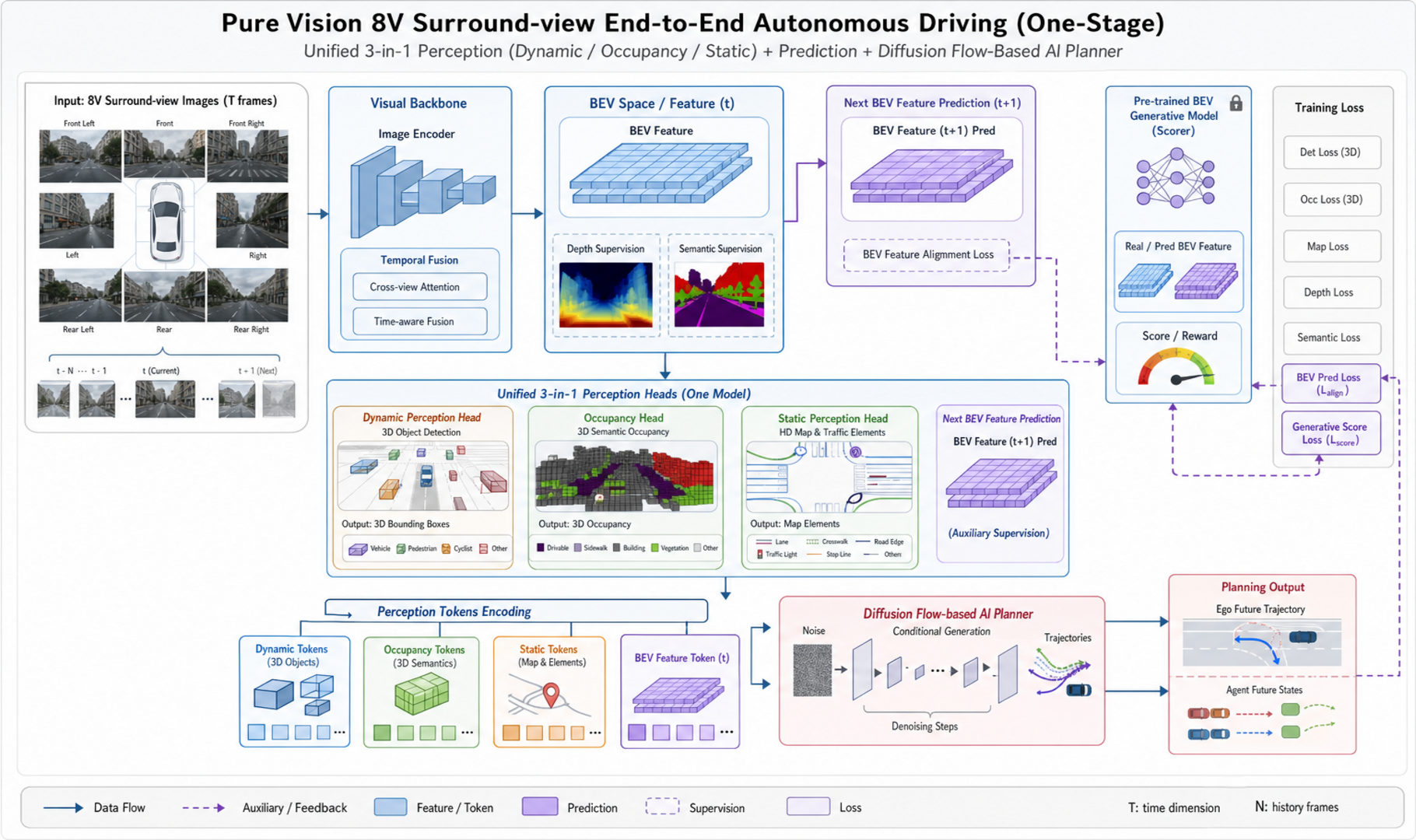
From pixels to planning in a single network: 8-camera surround vision → unified BEV → three perception heads → self-supervised future-BEV prediction → a Diffusion-Flow AI planner, all trained end-to-end with no hand-designed 3D-label interface.
Overview
What is this project about?
A modular driving stack hands 3D boxes from perception to planning. That interface quantises away everything the planner was not told to expect, and it blocks gradients — so nothing downstream can tell perception what it actually needed.
One network from pixels to trajectory. Eight surround cameras are lifted into a single shared BEV feature; 3D detection, online HD mapping and 3D occupancy all read that same feature; a self-supervised next-frame BEV forecast, scored by a frozen generative prior, makes the representation carry dynamics; and everything is tokenised into a Diffusion-Flow planner that denoises the ego trajectory and its neighbours' futures together.
Perception, prediction and planning are optimised jointly: the planner's loss reaches back through the tokeniser and the BEV into the backbone, so perception is trained for what planning needs rather than for a detection benchmark.
My role. I integrated the static-perception, dynamic-perception and AI-planner components into the single one-model POC, and ran the daily train / eval / visualisation loop. Wording is kept high-level for enterprise confidentiality.
View as tablesame content, no interaction needed
| Stage | Input | Logic | Output | Why / role |
|---|---|---|---|---|
| 8V Surround Cameras Input | Eight surround cameras, several consecutive frames | Sample a synchronised multi-view, multi-frame clip | Raw multi-view image streams | Cameras are the only sensor already on every trim level, so a vision-only stack is the one that can actually ship at volume. |
| Vision Backbone Backbone | Per-camera image streams | Cross-view attention across cameras, temporal fusion across frames | Geometry-aligned, motion-aware view features | Fusing across views and time before the lift means overlap regions and motion are resolved once, not re-derived by every downstream head. |
| Unified BEV Feature Lift | Aligned multi-view features | Lift perspective features into one bird's-eye feature volume | One BEV feature, shared by every downstream branch | One shared hub instead of a per-task neck: the heads cannot drift apart, and adding a head costs a decoder rather than a second pyramid. Trade-off. A shared trunk means head losses compete for capacity — the joint loss weighting becomes the thing you actually tune. My role. Owned the integration that made a single BEV serve static perception, dynamic perception and the planner in one model. |
| 3D Detection Perception | Shared BEV feature | Regress 3D boxes and per-object motion | Dynamic agents with velocity | Reading boxes off the shared BEV keeps detection in the same frame as the map and the planner, so no re-projection step can lose accuracy. |
| Online HD Map Perception | Shared BEV feature | Decode lane elements and their topology | Vectorised local map | Building the map online removes the dependency on a pre-surveyed HD map, which is the single biggest cost blocker for wide deployment. |
| 3D Occupancy Perception | Shared BEV feature | Predict a dense, class-labelled occupancy volume | Occupied and free space | Boxes cannot describe a fallen ladder or an open tailgate; a dense volume catches the long-tail geometry that boxes silently drop. Trade-off. Dense volumes are the most expensive head in the stack — resolution is traded directly against latency. |
| Future BEV t+1 Auxiliary train-only | Current BEV feature | Forecast the next-frame BEV; the real next frame is the label | Predicted next-frame BEV (training only) | Forcing the BEV to predict its own future makes it encode scene dynamics, not just a snapshot — and it costs no extra annotation. Trade-off. It is free supervision but not free compute: it is dropped at inference, so the car never pays for it. |
| Generative Critic Prior frozen | Predicted next-frame BEV | Score realism against a pretrained generative prior | Realism signal for the forecast loss | A pure regression loss lets forecasts blur into the mean; a frozen generative prior keeps them on the manifold of scenes that actually occur. Trade-off. Frozen means cheap and stable, but the prior can only judge what its pretraining covered. |
| Scene Tokens Interface | Detection, map, occupancy and the BEV feature | Encode heterogeneous outputs into one token sequence | Conditioning tokens | Tokens replace the hand-designed 3D interface between perception and planning — the piece that normally quantises away information and blocks gradients. |
| Diffusion-Flow Planner Plan | Scene tokens | Denoise a trajectory out of noise, conditioned on the tokens | A distribution over plans, not a single guess | A generative planner represents genuinely ambiguous situations (yield or go) as multiple modes, where a regression planner averages them into an unsafe middle. Trade-off. Multi-step denoising costs more than a single forward pass — the step count is the knob between plan diversity and latency. My role. Integrated the planner with the perception stack and ran the daily train / eval / visualisation loop for the joint model. |
| Ego + Agent Futures Output | Denoised plan | Emit the ego trajectory together with neighbouring-agent states | Scene-consistent future trajectories | Planning the ego and its neighbours in one shot keeps the plan internally consistent — the ego cannot assume a future the other agents contradict. |
The architecture, end to end